
Goal setting
How to Set Goals and Actually Achieve Them: 9 Research-Informed Goal-Planning Frameworks
What psychology, university research, leading technology companies, and Iron Future's own goal-completion data reveal about creating a life plan that connects your five-year vision to what you do today.
Most people know how to set a goal. Far fewer have a realistic plan for achieving it.
You might want to change careers, start a business, improve your health, strengthen your relationships, become financially independent, or learn something new. These goals can be important and genuinely motivating. Yet even a meaningful goal can remain unfinished if it never becomes part of your weekly schedule.
The problem isn't always a lack of ambition or discipline. Often, there is a missing connection between the future you envision and the time, effort, habits, and decisions required to get there.
Decades of research in psychology and behavioral science have examined that gap. The findings point to several useful practices: choosing meaningful goals, defining clear outcomes, anticipating obstacles, identifying specific actions, monitoring progress, and adapting plans when circumstances change.
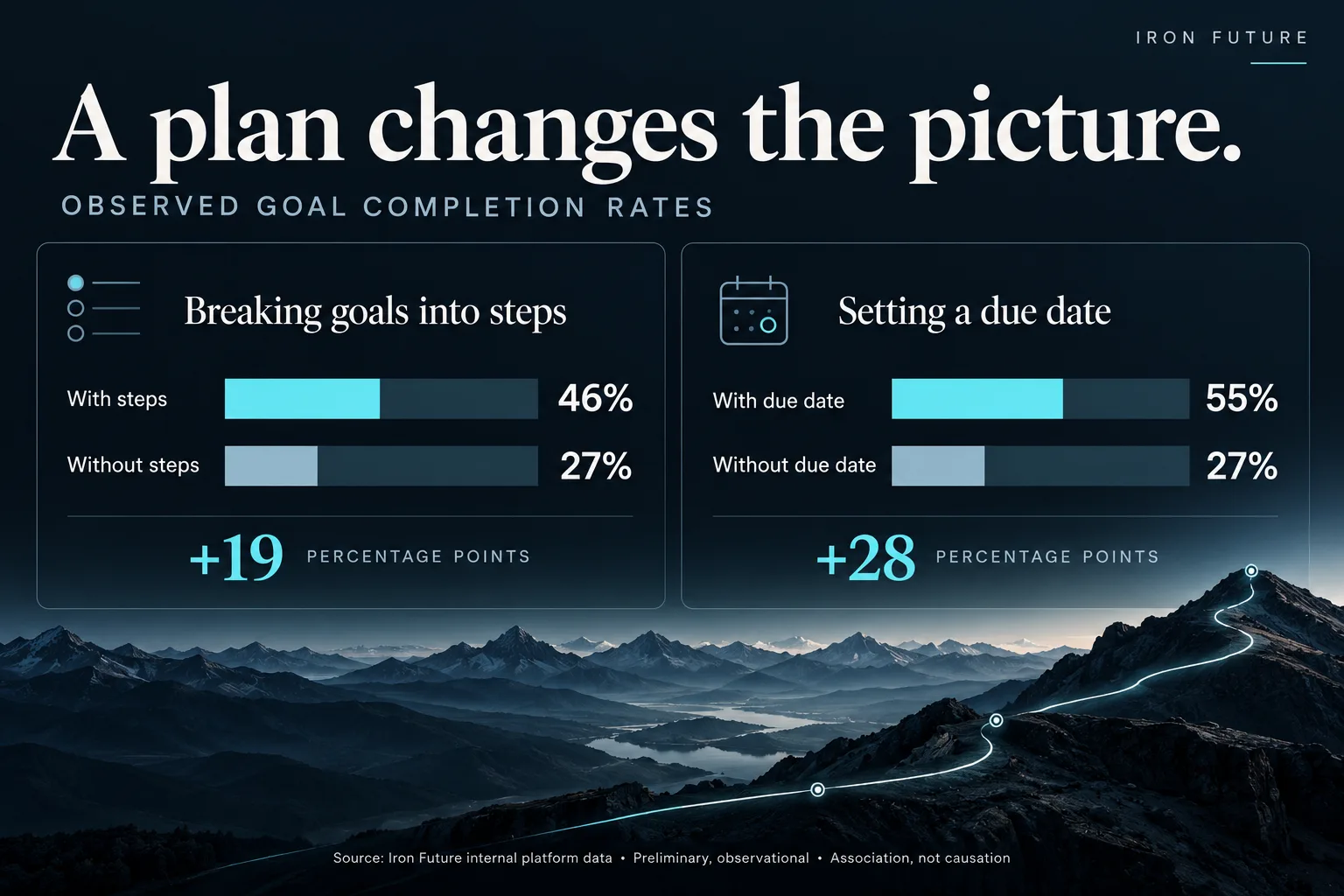
Data reported by Iron Future, a life-planning platform, suggests similar patterns among goals recorded in its system:
- Goals broken into steps had a reported completion rate of 46%, compared with 27% for goals without steps.
- Goals with due dates had a reported completion rate of 55%, compared with 27% for goals without due dates.
- Goals created on Sunday had the highest observed completion rates, followed by Tuesday and Friday.
These are preliminary, observational platform findings, not controlled experiments. They cannot establish that adding steps, setting deadlines, or creating a goal on a particular day causes better outcomes. Still, they raise interesting questions about how people translate intentions into action.
This guide examines nine goal-setting frameworks and planning methods, the evidence behind them, and how to combine them into a personal life plan spanning five years, one year, one month, one week, and one day.
What Does Research Say About Goal Setting?
The research supports an important distinction: setting a goal and pursuing a goal are separate processes.
In a 2017 systematic review and meta-analysis published in the Journal of Consulting and Clinical Psychology, researchers Tracy Epton, Sinead Currie, and Christopher Armitage examined 141 papers involving 16,523 participants.
They found that goal setting had a small positive effect on behavior change, with an average standardized effect size of d = 0.34.
Read the research: Unique Effects of Setting Goals on Behavior Change
That finding supports goal setting as a useful behavioral intervention. But it does not mean that everyone who sets a goal becomes 34% more successful, nor does it establish one universally effective planning method.
Other studies suggest that the way goals are implemented matters considerably.
| Research Area | Key Finding | Practical Implication |
|---|---|---|
| Goal setting | Meta-analysis of 141 papers found a small positive behavioral effect. | Define a meaningful, specific goal. |
| Implementation intentions | A meta-analysis of 94 tests found a positive effect on goal attainment (d = 0.65). | Create specific if–then action plans. |
| Progress monitoring | A meta-analysis of 138 studies found improved goal attainment (d = 0.40). | Record and review progress. |
| Backward planning | Experimental research found advantages for planning complex goals backward. | Start with a future outcome and identify preceding milestones. |
| Habit formation | Automaticity developed at widely varying rates across participants. | Repeat useful actions without expecting instant habits. |
Sources: Epton et al. (2017); Gollwitzer and Sheeran (2006); Harkin et al. (2016); Park et al. (2017); Lally et al. (2010). Research designs, populations, and outcomes differ, so effect sizes should not be directly compared as if they were results from one experiment.
The broader lesson is that an effective goal-planning system needs to address more than motivation. It must also address execution.
1. Values-Aligned Goal Setting: Choose Goals That Actually Matter to You
The first challenge in goal planning is deciding which goals deserve your attention.
People pursue goals for different reasons. Some reflect personal interests and values. Others arise from external pressure, comparisons, or expectations.
Psychologists Kennon Sheldon and Andrew Elliot explored this distinction through the self-concordance model.
Their 1999 research, published in the Journal of Personality and Social Psychology, examined goals that align with a person's interests and core values.
Across three longitudinal studies, greater self-concordance was associated with sustained effort and greater goal attainment. Achieving self-concordant goals was also associated with benefits to psychological well-being.
Read the original research: The Self-Concordance Model
The implication is not that externally motivated goals are worthless, but that your reasons for pursuing a goal may influence your willingness to persist.
How to Apply Values-Aligned Goal Setting
Before committing to a major goal, ask yourself:
- Why do I want this?
- What part of my life would it improve?
- Would I still want it if nobody else knew I had achieved it?
- What am I willing to give up or change to pursue it?
- How does it fit alongside my other responsibilities and priorities?
For example, "earn more money" might become "build enough financial security to choose work that gives me more time with my family."
The second version connects a financial outcome to a personal value.
Plan for Your Whole Life, Not Just Your Career
A comprehensive life plan can consider several interconnected areas:
- Career and meaningful work
- Financial stability
- Physical health and well-being
- Relationships and family
- Personal growth and education
- Recreation, community, and experiences
Not every area needs an ambitious achievement target. Some may need ongoing maintenance, flexibility, or protection from competing priorities.
Yale School of Management has similarly highlighted the importance of balancing motivation, progress, competing goals, and social support in its discussion of psychologist Ayelet Fishbach's research.
Yale School of Management: Unlocking Insights to Self-Motivation
Best use: Choosing your long-term direction and identifying the few goals that justify a meaningful commitment of time.
2. SMART Goals and Goal-Setting Theory: Make Success Specific
"I want to be healthier" communicates a desire, but it doesn't tell you exactly what to do or how to recognize success.
A more actionable goal might be:
Build a consistent walking routine of four 30-minute walks each week over the next three months.
The second statement describes a specific behavior, a frequency, and a timeframe.
The SMART Goal-Setting Framework
SMART is commonly used to structure goals:
- Specific: Define the result you want.
- Measurable: Decide how progress will be assessed.
- Achievable: Consider your ability, resources, and constraints.
- Relevant: Connect the goal to your broader priorities.
- Time-bound: Establish a deadline or review period.
The deeper scientific foundation comes from goal-setting theory, particularly research by psychologists Edwin Locke and Gary Latham.
Their landmark 2002 review summarized approximately 35 years of research into the relationship between goal characteristics, motivation, and performance.
Under appropriate conditions, specific and challenging goals can improve performance relative to vague or less demanding goals. However, the effects depend on factors including commitment, feedback, ability, and task complexity.
Locke and Latham: Building a Practically Useful Theory of Goal Setting
Is SMART Scientifically Proven?
An important distinction is that evidence supporting specific, challenging goals is not the same as validation of every component of the SMART acronym.
A 2022 review in Health Psychology Review questioned the scientific foundations and inconsistent application of SMART goals, particularly in physical activity research.
The (Over)use of SMART Goals for Physical Activity Promotion
SMART can be a useful checklist, but it should not be treated as a complete behavioral change system.
For complex or unfamiliar goals, learning objectives may also be more appropriate than immediate performance targets.
For instance, "complete three customer interviews to understand the market" may be a better early goal than "generate $100,000 in revenue" when someone has never launched a business.
Best use: Defining measurable outcomes and creating clarity about what success looks like.
3. Objectives and Key Results (OKRs): Connect Ambition to Measurable Progress
Technology companies have developed their own approaches to goal planning.
One of the most influential is Objectives and Key Results, commonly called OKRs.
Google's published OKR playbook distinguishes between an objective, which describes what should be accomplished, and key results, which provide measurable evidence of progress toward that objective.
Example: An OKR for Personal Financial Planning
Objective: Build stronger financial security.
Key results:
- Establish an emergency fund equivalent to three months of essential expenses.
- Eliminate a specific outstanding credit-card balance.
- Set up and maintain an automated monthly savings contribution.
Unlike a simple task list, these key results focus on outcomes.
"Review my bank account" is an activity. "Build a three-month emergency fund" is a measurable result.
How OKRs Apply to Life Planning
OKRs are predominantly a business and organizational planning framework. Their success in company use is not proof that they are superior for every personal goal.
However, the distinction between outcomes and activities transfers well to personal planning.
A five-year vision can establish direction, annual outcomes can define results, and weekly activities can represent the work required to achieve them.
Best use: Translating broad life ambitions into a small number of measurable outcomes.
4. Backward Planning: Connect Your Five-Year Vision to Today's Actions
A major weakness of many personal goal-setting systems is that they focus on either the distant future or the immediate task list, but rarely connect the two.
Backward planning addresses this problem.
Instead of asking only what you can do today, you begin with a future result and work backward to identify the milestones and actions required.
Researchers Jooyoung Park, Fang-Chi Lu, and William Hedgcock investigated this approach in a 2017 study published in Psychological Science.
Their experiments found that backward planning, compared with forward planning, could improve motivation, goal expectancy, and goal-relevant performance, particularly for complex goals.
Relative Effects of Forward and Backward Planning on Goal Pursuit
This does not establish that every person needs a five-year plan, or that one particular time horizon is psychologically optimal. Rather, it supports the value of thinking carefully about the sequence of actions needed to reach a complex outcome.
The Five-Year-to-Daily Planning Method
Consider someone whose long-term ambition is to build an independent design business.
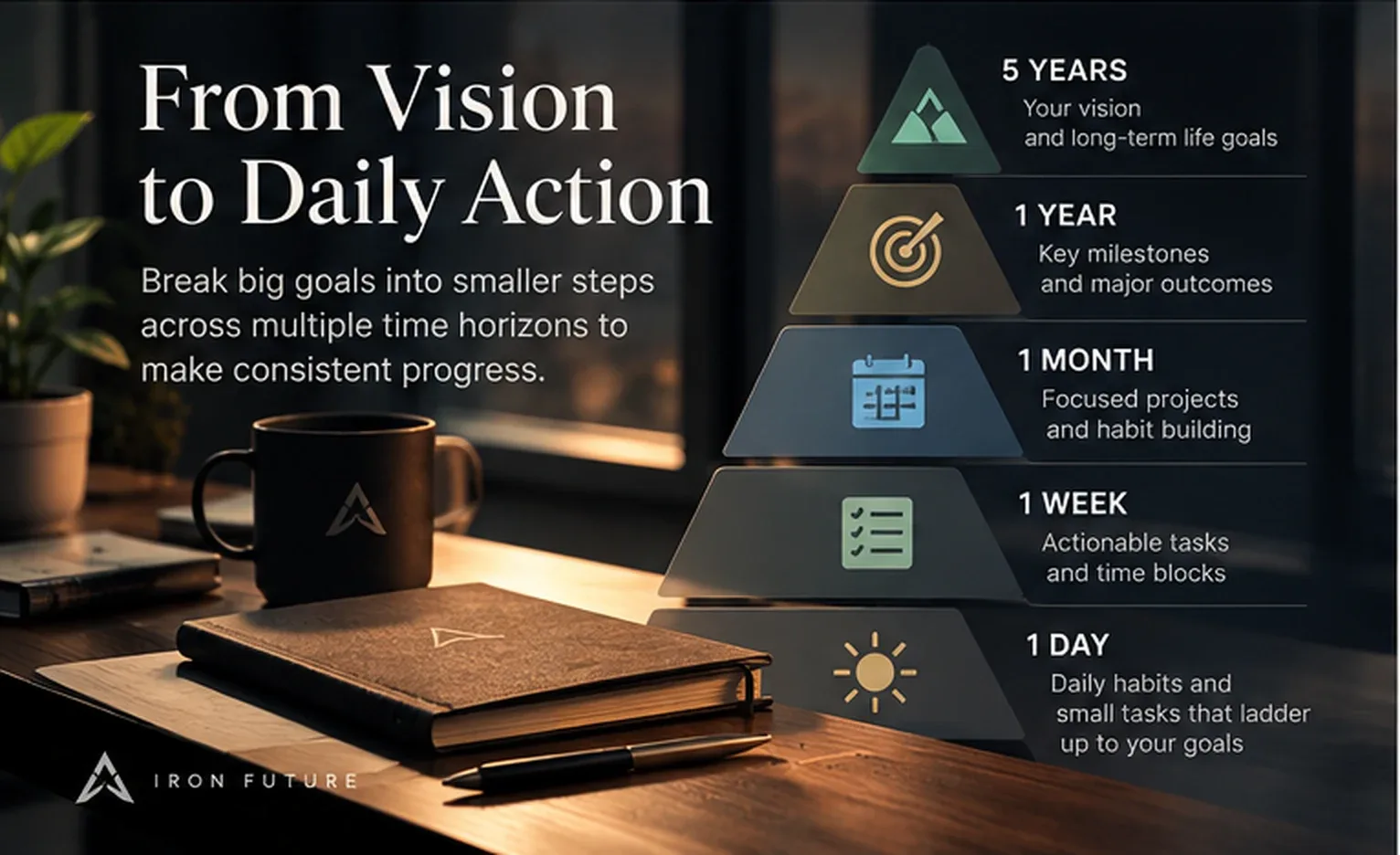
| Timeframe | Example Goal or Action |
|---|---|
| Five-year vision | Own an established independent design studio. |
| One-year goal | Build a portfolio and secure three paying clients. |
| One-month milestone | Publish a portfolio with three case studies. |
| One-week priority | Complete the first case study and contact five potential clients. |
| Today's action | Spend 30 minutes drafting the case study. |
| Recurring habit | Work on the business for 30 minutes on three scheduled mornings. |
The five-year outcome gives direction. The annual goal establishes a nearer destination. The monthly milestone narrows the immediate problem. The weekly plan identifies priorities. The daily action makes it possible to begin.
A recurring habit supports the goal between milestones.
This is the central idea behind Iron Future's connected life-planning approach: goals exist across multiple timeframes rather than as isolated entries on a to-do list.
Why the Connection Matters
A daily task can appear productive without contributing to a meaningful objective.
An impressive five-year vision can feel exciting without changing what someone does this week.
Connecting the two makes it easier to ask:
Does the work I'm doing today support the life I'm trying to build?
The answer will not always be yes. Many necessary parts of life are maintenance rather than milestones, and they still deserve time.
But when a person is intentionally pursuing a long-term goal, that connection can provide a practical basis for deciding what to prioritize.
Best use: Long-term life planning, career development, complex projects, and turning ambitious goals into manageable steps.
5. WOOP: Prepare for the Obstacles That Interfere With Your Plan
Even a well-defined goal can fail if it assumes everything will go according to plan.
The WOOP framework, associated with psychologist Gabriele Oettingen's research, brings obstacles into the planning process.
WOOP stands for:
- Wish: What do you want?
- Outcome: What positive result would achieving it create?
- Obstacle: What internal obstacle could interfere?
- Plan: What will you do when that obstacle appears?
Example: Building a Consistent Exercise Routine
Wish: Exercise regularly.
Outcome: Feel stronger and improve physical fitness.
Obstacle: Feeling too tired after work.
Plan: If I feel exhausted when it's time to exercise, I'll begin with a ten-minute walk rather than skipping the session entirely.
WOOP combines mental contrasting with implementation intentions.
A 2021 meta-analysis of 21 studies and 15,907 participants found a small-to-moderate positive average effect on goal attainment (g = 0.336). The authors also identified possible publication bias, meaning the true average effect could be smaller.
Meta-Analysis of Mental Contrasting With Implementation Intentions
Why Obstacle Planning Is Valuable
Plans are often built around ideal circumstances.
But real life includes competing obligations, unexpected events, fatigue, changing priorities, and limited resources.
Identifying obstacles before they happen helps make a plan more adaptable.
Best use: Personal goals that have stalled repeatedly, behavior change, and goals requiring sustained effort.
6. Implementation Intentions: Turn Good Intentions Into Specific Actions
WOOP identifies obstacles and responses. Implementation intentions provide a broader technique for connecting situations to actions.
The basic structure is:
If [a situation occurs], then I will [take a specific action].
For example:
"If it is 7:30 a.m. on Tuesday or Thursday, then I will spend 20 minutes studying Spanish."
Or:
"If I miss my scheduled study session, then I will complete a five-minute review before bed."
Implementation intentions help specify the conditions under which someone will act.
In a 2006 meta-analysis of 94 independent tests, researchers Peter Gollwitzer and Paschal Sheeran reported a positive effect on goal attainment (d = 0.65).
A 2025 review in the Annual Review of Psychology further examined how if–then plans relate to attention, decision-making, emotion regulation, and behavior change.
Psychology of Planning — Gollwitzer and Sheeran, 2025
Yale School of Management has also highlighted if–then plans as a way of addressing the gap between intentions and actions.
Yale: Why Do Many New Year's Resolutions Fail?
Implementation Intentions Versus Ordinary Scheduling
Scheduling says when you intend to do something.
An if–then plan connects a recognizable situation with a response.
These methods can work together.
A calendar reserves the time. An implementation intention helps determine what happens when that moment arrives or an obstacle interrupts it.
Best use: Reducing procrastination, initiating recurring activities, and responding to predictable distractions.
7. Habit-Based Goal Planning: Turn Small Repeated Actions Into Long-Term Progress
Not every goal can be completed through one-time tasks.
Learning a language, improving fitness, developing a professional skill, or maintaining meaningful relationships often requires repeated behavior.
That creates an important distinction:
- Goals describe outcomes.
- Tasks describe specific pieces of work.
- Habits describe recurring behaviors that support those outcomes.
| Goal | Supporting Task | Recurring Habit |
|---|---|---|
| Learn Spanish | Complete the first beginner lesson. | Practice for 15 minutes four times a week. |
| Build a business | Publish a portfolio. | Work on customer outreach three times a week. |
| Strengthen friendships | Schedule a reunion. | Reach out to a friend each Friday. |
| Improve financial organization | Create a budget. | Review spending every Sunday. |
Tasks help move a goal toward completion. Habits create opportunities for continued progress.
What Does Habit Research Say?
A 2010 study by Phillippa Lally and colleagues examined habit formation in everyday life.
Participants repeated eating, drinking, or activity behaviors in consistent contexts. The modeled time to reach a high level of automaticity varied from 18 to 254 days.
How Are Habits Formed? Modelling Habit Formation in the Real World
This variation challenges the idea that every habit becomes automatic after a fixed number of days.
It also emphasizes the value of selecting realistic behaviors and repeatable contexts.
The Connection Between Habits and Life Goals
A habit becomes more meaningful when its purpose is clear.
A 15-minute study streak is not the same as mastering a language. But it can represent consistent effort toward that objective.
Iron Future's goal tracker links recurring habits with longer-term goals, allowing people to see what their repeated actions are intended to support.
This helps distinguish activity from progress.
For a language goal, for example, you might track both practice sessions and real-world conversational ability.
If your streak continues but your ability isn't improving, the solution may be to change the practice method rather than simply preserving the streak.
Best use: Goals requiring repetition, maintaining routines, and supporting long-term development.
8. Capacity Planning: Make Sure Your Goals Fit the Time You Actually Have
One of the most overlooked parts of personal goal setting is capacity.
It's possible to create a detailed plan that cannot realistically fit into your life.
You might have three goals that each require five hours of work per week, but only eight hours available after work, family responsibilities, health needs, and other commitments.
Each goal looks reasonable when considered independently.
Together, they require fifteen hours from an eight-hour budget.
That's not a motivation problem. It's a planning problem.
The Psychology of Underestimating Effort
Researchers have studied the planning fallacy: the tendency to underestimate how long future tasks will take.
A 1994 paper by Roger Buehler, Dale Griffin, and Michael Ross found that people's task-completion predictions were often too optimistic.
A later review coauthored by a researcher affiliated with the University of California, San Diego, examined another possible explanation: people may systematically underestimate how long similar past activities actually took.
Underestimating the Duration of Future Events — Psychological Bulletin
These findings highlight why effort estimates should be tested against experience rather than relying exclusively on optimistic assumptions.
How to Estimate the Effort Required for a Goal
Begin by breaking a goal into smaller components.
Estimate the hours needed for each component, then consider:
- How much total effort does the goal require?
- What is the deadline?
- How many weeks are realistically available?
- What recurring activities will support the goal?
- How much weekly capacity can you devote to it?
- What other goals compete for the same time?
A useful starting calculation is:
Required weekly effort = Estimated remaining goal hours ÷ Available weeks
For example, a project requiring an estimated 120 hours over 24 weeks would require an average of five hours per week.
That is a planning estimate, not a guarantee. It assumes the work can be distributed across the period and does not yet include unexpected delays.
Compare Your Goals Against Total Capacity
Imagine you have eight hours per week available for discretionary goal-related work.

| Goal | Estimated Weekly Effort |
|---|---|
| Build a side business | 4 hours |
| Fitness training | 3 hours |
| Learn a language | 2 hours |
| Financial planning | 1 hour |
| Total required | 10 hours |
| Available capacity | 8 hours |
Your plan exceeds capacity by two hours per week.
Over twelve weeks, that is 24 hours of planned work with no available space.
Rather than assuming you will somehow become more productive, you can make a deliberate trade-off.
You could temporarily reduce the effort allocated to a goal, extend a deadline, pause a lower-priority project, or find additional capacity without compromising important responsibilities.
What Technology Companies Have Learned About Capacity
Capacity planning is already a recognized discipline in workplace project management.
Asana's Workload functionality allows teams to assign estimated effort to tasks, establish capacity limits, and identify situations where work exceeds available resources.
Asana: Workload and Capacity Management
Iron Future applies a related concept to personal planning through its Atlas Planning Technology.
Atlas compares estimated goal effort with available time and identifies competing commitments across a person's life plan. It also incorporates recorded completion pace and life-area focus to provide additional context.
Its goal odds are heuristic estimates, not scientifically validated predictions of individual success.
The distinction matters: an estimate can support better decisions without being an exact forecast.
Capacity Is More Than Available Hours
Two hours of uninterrupted focused work aren't necessarily interchangeable with two hours of fragmented time.
Energy, attention, finances, caregiving, accessibility, travel, and recovery can all affect someone's ability to follow a plan.
A realistic system should leave room for these constraints.
Best use: Managing competing life goals, preventing chronic overcommitment, estimating timelines, and deciding when to adjust priorities.
9. Progress Monitoring and Reflection: Build a System That Learns
A plan should not be treated as a fixed prediction of the future.
Your priorities can change. A task might require more time than expected. A new opportunity might become more valuable than an old goal.
Monitoring helps identify these changes while there is still time to respond.
The Research on Goal Tracking
A 2016 meta-analysis published in Psychological Bulletin examined 138 studies involving 19,951 participants.
The researchers found that interventions increasing progress monitoring also improved goal attainment, with an average effect of d = 0.40.
Effects were larger under conditions involving physically recorded or reported progress.
Does Monitoring Goal Progress Promote Goal Attainment?
The evidence supports monitoring as a useful self-regulation strategy. It does not establish that a particular tracking app, score, or review frequency is best for everyone.
What Should You Actually Track?
A complete goal-planning system can track three different things:
- Outcomes: Did the desired result happen?
- Processes: Did you complete the actions that support the result?
- Capacity: Did the work fit into the time and resources available?
For example, someone trying to launch a business might track customer revenue as an outcome, outreach conversations as a process, and weekly work hours as a measure of effort.
These measures reveal different problems.
If you're consistently taking action but not getting results, the strategy may need improvement.
If the strategy is working but you cannot complete the planned workload, your commitments may exceed your capacity.
If neither actions nor results are progressing, your priorities or plan may need a more fundamental review.
The Importance of Reflection
Iron Future includes daily, weekly, and monthly reflections, alongside a Playbook feature designed to surface patterns in how someone plans and works.
A weekly review might ask:
- What did I accomplish this week?
- Which goals moved forward?
- What took more time than expected?
- Which habits supported my progress?
- What prevented me from following the plan?
- What should change next week?
The purpose is not merely to document activity. It's to improve future decisions.
Best use: Maintaining long-term direction, identifying stalled goals, and adapting plans to real circumstances.
What Iron Future's Goal-Completion Data Reveals
Academic research examines goal-setting methods under different experimental and observational conditions.
Planning platforms also offer another source of information: aggregate patterns in the goals people actually record and manage.
Iron Future reports several preliminary patterns from goals within its platform.
Finding 1: Goals With Steps Show Higher Completion Rates
| Goal Structure | Reported Completion Rate |
|---|---|
| Goals broken into steps | 46% |
| Goals without steps | 27% |
Difference: 19 percentage points.
Goals with recorded steps had approximately 1.7 times the observed completion rate of goals without steps.
This is consistent with the practical reasoning behind action planning and backward planning.
However, the difference does not prove that breaking a goal into steps caused the improvement.
People who invest time in creating steps may also be more committed, may choose different kinds of goals, or may have different resources available.
There may also be differences in how goals were classified or how long they had been active.
The most reasonable interpretation is that goal structure is an interesting correlate of completion worth investigating further.
Finding 2: Goals With Due Dates Show Higher Completion Rates
| Deadline Status | Reported Completion Rate |
|---|---|
| Goals with a due date | 55% |
| Goals without a due date | 27% |
Difference: 28 percentage points.
Goals with due dates had just over twice the observed completion rate of goals without due dates.
A deadline can make a target easier to evaluate and may encourage someone to allocate time toward it.
But the association may have other explanations.
Short, clearly defined goals may be more likely to receive dates than ambitious or open-ended goals. Goals without deadlines may include lifelong aspirations or bucket-list items that aren't intended to be completed soon.
Therefore, not every meaningful goal needs an arbitrary deadline.
A five-year career transition might benefit from dated milestones, while an aspiration to travel more throughout life could reasonably remain open-ended.
The important question is whether a deadline serves the goal.
Finding 3: Sunday-Created Goals Show the Highest Completion Rates
Iron Future also reports a day-of-week pattern in goal completion.
Among goals grouped by their creation day:
- Sunday: Highest observed completion rate.
- Tuesday: Second-highest.
- Friday: Third-highest.
- Wednesday and Saturday: Lowest observed completion rates.
This is a particularly interesting finding because it raises the possibility that the context in which a goal is created matters.
One relevant psychological concept is the fresh start effect.
In a 2014 paper published in Management Science, researchers Hengchen Dai, Katherine Milkman, and Jason Riis found increases in aspirational behaviors following temporal landmarks, including the beginning of a new week, month, or year.
The Fresh Start Effect: Temporal Landmarks Motivate Aspirational Behavior
The researchers examined behaviors such as online searches, gym visits, and commitments to pursue goals.
Their findings provide a plausible theoretical connection between temporal landmarks and motivation.
However, they do not establish that goals created on Sundays are more likely to succeed than goals created on other weekdays.
Iron Future's pattern might reflect when users perform weekly planning, differences in goal types, work schedules, user characteristics, or other factors.
A useful practical experiment is to choose a consistent weekly planning day, such as Sunday, and see whether it improves your own follow-through.
But Sunday is not a scientifically established universal best day for goal setting.
How to Interpret This Platform Data Responsibly
Research disclosure: These figures are preliminary aggregate statistics reported by Iron Future and supplied for this article. They have not been independently audited or peer-reviewed. The underlying sample sizes, observation period, population characteristics, goal-completion definitions, and statistical uncertainty have not been provided here.
The figures describe associations among recorded goals, not causal effects. They should not be generalized to all users or interpreted as individual predictions of success.
The analysis would be stronger with a published methodology, including the number of goals in each group, how unfinished goals were handled, and whether comparisons accounted for goal duration and complexity.
How to Build a Complete Personal Goal Plan
The most useful takeaway from the research is not that everyone needs to adopt nine separate frameworks.
It's that each method can address a different weakness in a planning process.
Here is a practical way to bring them together.
Step 1: Define Your Five-Year Direction
Consider your career, finances, relationships, health, personal growth, and experiences.
Describe what you would like to be true in five years.
Choose a small number of areas for active growth. Let other areas receive appropriate maintenance and attention.
Step 2: Establish One-Year Goals
For each priority, identify an outcome that would represent meaningful progress during the next twelve months.
Make the result specific enough to evaluate, while leaving room to revise it when circumstances change.
Step 3: Work Backward Into Monthly Milestones
Ask what needs to happen before the annual goal can be achieved.
Break the result into milestones with clear deliverables and, where appropriate, target dates.
Step 4: Estimate Your Effort and Available Capacity
Calculate how much work the active goals may require.
Compare that estimate with the time you actually have.
Avoid assigning the same hour to multiple goals.
Step 5: Select Weekly Priorities
At the beginning of the week, identify the most important actions that move your active goals forward.
For each, define a concrete result rather than simply writing a vague intention.
Step 6: Create Daily Actions and Recurring Habits
Translate weekly priorities into actions you can begin.
Use recurring habits for behaviors that need repetition and one-time tasks for work that can be completed.
Consider if–then plans for predictable obstacles.
Step 7: Review and Adjust
At the end of each week, compare intended progress with actual progress.
Review monthly milestones regularly and revisit longer-term goals when major circumstances or priorities change.
A good plan gives you direction without requiring you to predict every detail of the next five years.
A Complete Example: From Five-Year Vision to Daily Action
Imagine your long-term goal is to build a small independent consulting business while maintaining your health and relationships.
| Level | Planned Outcome or Activity |
|---|---|
| Life direction | Build more professional independence without sacrificing family life. |
| Five years | Operate a financially sustainable independent consultancy. |
| One year | Secure three recurring clients. |
| One month | Complete a portfolio and validate an initial service offering. |
| One week | Interview five potential customers and publish a case study. |
| Today | Draft the interview questions and contact two people. |
| Supporting habit | Schedule three focused business-building sessions per week. |
| Estimated effort | Four hours per week initially. |
| Capacity check | Confirm this fits alongside work, family, health, and other priorities. |
| Weekly review | Evaluate interviews, time spent, next actions, and competing commitments. |
This structure combines values alignment, outcome setting, backward planning, smaller steps, habits, capacity planning, and progress monitoring.
It does not guarantee business success. It makes the intended work more visible and easier to evaluate.
The same method can be adapted to personal goals such as learning a language, pursuing education, organizing finances, completing a creative project, or preparing for a major life transition.
How Technology Can Connect Your Goals, Habits, and Long-Term Plan
Different technology products emphasize different parts of the goal-planning process.
Google's OKR approach illustrates how organizations can connect objectives to measurable results.
Asana demonstrates how resource and workload planning can make the constraints behind ambitious projects visible.
Iron Future approaches these questions from the perspective of an individual's broader life rather than a company's projects.
Its planning system connects daily, weekly, monthly, annual, and five-year goals, along with a longer-term life timeline and bucket-list ambitions.
Its Goal Insights feature helps break goals into milestones and suggested habits. Its Weekly Plan organizes priorities across areas such as health, money, relationships, and personal growth.
Atlas adds estimated effort, available capacity, competing goals, and historical completion trends. The reflection and Playbook features provide a way to revisit what is and isn't working.
The underlying principle is straightforward:
Your long-term goals should inform what you do this week, and what you learn this week should inform your future plan.
No software can remove uncertainty, create unlimited time, or guarantee the outcome of a goal.
But a connected planning system can make it easier to see whether your commitments, actions, and longer-term priorities are aligned.
For an example of that approach, explore Iron Future's life plan template or its goal tracker.
Frequently Asked Questions About Goal Setting
What Is the Best Goal-Setting Framework?
No single framework has been demonstrated to work best for every goal. SMART can help clarify outcomes, WOOP helps prepare for obstacles, implementation intentions help initiate actions, and progress monitoring supports self-regulation. Complex goals may benefit from combining several approaches.
How Do You Set Personal Goals and Actually Achieve Them?
Start with a meaningful outcome, define how success will be measured, break the result into smaller steps, estimate the required effort, schedule realistic actions, and review progress. Adjust the plan when your available resources or priorities change.
How Do You Create a Five-Year Life Plan?
Define what you want to be true across important life areas in five years. Identify one-year outcomes supporting that vision, then work backward into monthly milestones and weekly actions. Keep the plan flexible and review it periodically.
How Do You Break Big Goals Into Smaller Steps?
Start with the completed outcome and identify what must happen immediately before it. Continue working backward until you reach tasks small enough to perform within your available schedule.
Do Deadlines Improve Goal Completion?
Deadlines can provide structure and make progress easier to evaluate. Iron Future's preliminary platform data shows higher completion rates among goals with due dates, but this does not establish causation. The usefulness of a deadline depends on the goal and its circumstances.
What Is the Difference Between a Goal, a Task, and a Habit?
A goal defines a desired result. A task is an individual action or deliverable. A habit is a recurring behavior that may support one or more goals. Effective planning connects these elements rather than treating them as interchangeable.
How Do You Estimate the Effort Required for a Goal?
Break the goal into smaller components, estimate the total hours, and divide the remaining work across a realistic number of weeks. Compare the resulting workload with your actual available capacity and revise estimates using experience.
Is Sunday the Best Day to Set Goals?
Iron Future's preliminary internal data shows the highest observed completion rate among goals created on Sunday. However, the finding is correlational, and there is no basis to conclude that Sunday is universally the best day. A consistent planning routine is a more defensible practical recommendation.
How Often Should You Review Your Goals?
A short weekly review and a more detailed monthly or quarterly review can provide a practical starting structure. Research supports progress monitoring, but it does not establish one ideal review interval for every type of goal.
Conclusion: The Best Goal-Setting System Connects Your Future to Your Present
An effective life plan requires more than ambition.
It requires clarity about what matters, a realistic understanding of your capacity, specific actions that support meaningful outcomes, and a willingness to learn from experience.
Psychological research supports several individual components of this process, including goal specificity, implementation intentions, backward planning, and progress monitoring.
Technology can help organize those components, while observational data from planning platforms can suggest additional questions worth researching.
The most practical lesson is to create a plan that works at multiple levels.
Know where you want to go in five years. Know what matters this year. Know what needs to happen this month. Know what you can accomplish this week. And know what you can begin today.
Then make room for the work, track what happens, and keep the plan current as your life evolves.
Ready to Connect Your Long-Term Goals to Your Everyday Actions?
Turn your long-term ambitions into milestones, weekly priorities, daily tasks, and habits with Iron Future.
References and Further Reading
Peer-Reviewed Research
- Epton, T., Currie, S., and Armitage, C. J. (2017). Unique effects of setting goals on behavior change: Systematic review and meta-analysis. Journal of Consulting and Clinical Psychology.
- Sheldon, K. M., and Elliot, A. J. (1999). Goal striving, need satisfaction, and longitudinal well-being: The self-concordance model. Journal of Personality and Social Psychology.
- Locke, E. A., and Latham, G. P. (2002). Building a practically useful theory of goal setting and task motivation. American Psychologist.
- Park, J., Lu, F.-C., and Hedgcock, W. M. (2017). Relative effects of forward and backward planning on goal pursuit. Psychological Science.
- Gollwitzer, P. M., and Sheeran, P. (2006). Implementation intentions and goal achievement: A meta-analysis of effects and processes. Advances in Experimental Social Psychology.
- Gollwitzer, P. M., and Sheeran, P. (2025). Psychology of Planning. Annual Review of Psychology.
- Wang, G., Wang, Y., and Gai, X. (2021). A meta-analysis of the effects of mental contrasting with implementation intentions on goal attainment. Frontiers in Psychology.
- Lally, P., van Jaarsveld, C. H. M., Potts, H. W. W., and Wardle, J. (2010). How are habits formed? Modelling habit formation in the real world. European Journal of Social Psychology.
- Harkin, B., et al. (2016). Does monitoring goal progress promote goal attainment? A meta-analysis of the experimental evidence. Psychological Bulletin.
- Roy, M. M., Christenfeld, N. J. S., and McKenzie, C. R. M. (2005). Underestimating the duration of future events: Memory incorrectly used or memory bias? Psychological Bulletin.
- Dai, H., Milkman, K. L., and Riis, J. (2014). The fresh start effect: Temporal landmarks motivate aspirational behavior. Management Science.
- The (over)use of SMART goals for physical activity promotion: A narrative review and critique. (2022). Health Psychology Review.
University and Industry Perspectives
- Yale School of Management: Unlocking Insights to Self-Motivation.
- UC San Diego Center for Healthy Eating and Activity Research: The Importance of Goal Setting.
- Harvard Kennedy School: Goals Gone Wild — The Systematic Side Effects of Overprescribing Goal Setting.
- Google's OKR Playbook.
- Asana: Workload and Capacity Planning.
Product and Observational Data
- Iron Future: Planning Features and Atlas.
- Iron Future preliminary internal goal-completion statistics supplied for this article. Sample sizes, observation dates, methodology, and validation status should accompany any formal research release.
Research note: This article synthesizes published findings and practical planning methods. The combination of frameworks described here has not itself been established as a scientifically validated intervention. Neither the research nor the platform statistics guarantee an individual's goal achievement.